The Lead Keel: Resilience and Memory of an Impact
In the world of sailing, the keel is a fundamental element for the stability and safety of a sailboat. Among the various types of keels, those made of lead offer unique characteristics that deserve to be explored, especially when discussing their resilience after an impact with the seabed.
Characteristics of the Lead Keel:
The lead keel is appreciated for its ability to maintain a low center of gravity, contributing to greater stability of the vessel. One of the most fascinating characteristics of lead is its density and malleability, allowing for the manufacture of relatively thin but effective keels. When a sailboat with a lead keel suffers a blow—such as during careless navigation in shallow waters—it is common for the keel to become damaged. However, lead has the peculiarity of “remembering” the impact, showing visible traces of the collision. This characteristic is an advantage as it allows for the identification and assessment of the extent of the damage. The deformations caused by the impact remain visible and can provide valuable clues on how to intervene for repairs. Experienced surveyors can easily recognize that even after being repaired, the lead keel retains its “memory” of contact with the seabed, thus becoming part of the vessel’s history.
Comparison with Cast Iron Keels:
Cast iron keels, on the other hand, are another common option and present different characteristics. Although cast iron is more durable and resistant to impacts, it tends to fracture rather than deform. This means that a blow could result in more serious damage, with potentially more complex and costly repairs. Unlike lead, a cast iron keel might not “remember” the impact, making diagnosis and repair intervention more difficult.
How to Recognize Signs of a Collision on the Lead Keel:
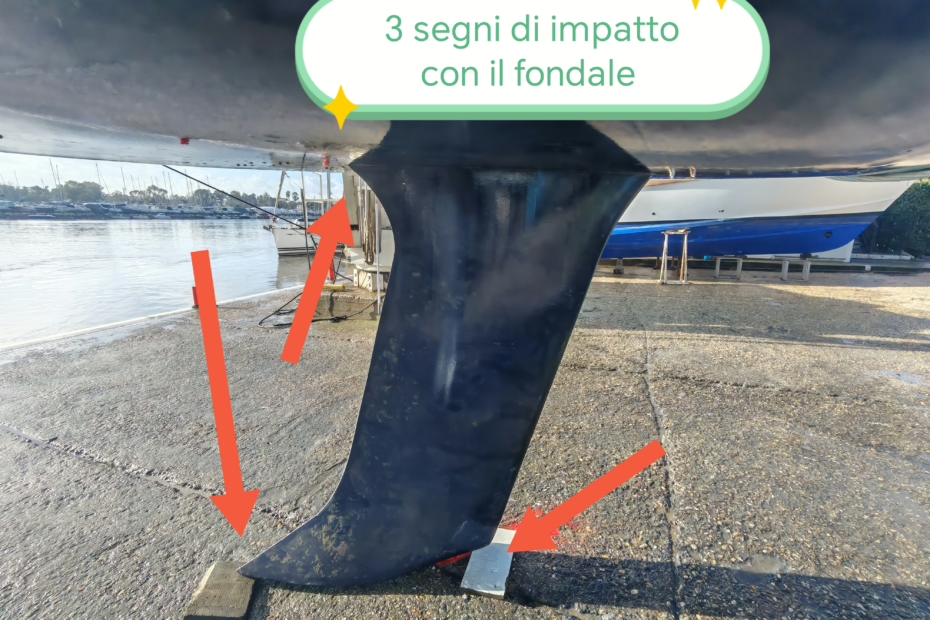
The lead keel typically has three specific points that show the impact:
- On the leading edge against the hull, the stern side which tends to bend due to compression.
- On the underside, there is often damage to the leading edge.
- The trailing edge, which, because it is usually tapered, appears bent upwards.
In the case of the boat in question, I found all three signs on the fin, and I proceeded with specific analyses to understand whether the boat had indeed hit a rock in its past and had been repaired. I should point out that the seller, in good faith, was unaware of this and had purchased the boat years earlier; evidently, it had been sold to him while concealing its history, and no one had ever noticed.
Now you may wonder what I did inside? I inspected the stringer immediately aft of the bulb plates and the relevant area. Everything appeared perfect; the repair had indeed been performed with particular aesthetic skill.
I then used two tools, as I obviously could not remove the paint: the first was an ultrasonic thickness gauge, with which I detected and confirmed my theory of the repaired boat, noticing that the thickness in the worked areas was greater than that of the mold stringers far from the area in question. This difference in thickness I attribute to post-construction work and therefore to an increased amount of fiberglass.
I then used a simple hygrometer, which detected different humidity values between the area in question and other areas of the mold; this likely indicates that the repair was not perfect from the composite standpoint.
In summary, the repair was executed very well from an aesthetic point of view, although not impeccable from a structural standpoint. Lead once again proved to be a good ally for the expert, as it provided tangible clues regarding the boat’s past and its condition.
In conclusion, these aspects underline the importance of careful and thorough evaluation when it comes to vessels, especially concerning past incidents that could affect performance and safety. The lead keel not only contributes to the vessel’s stability but also offers a useful tool for diagnosing and intervening in case of damage due to its capacity to “remember” impacts. This aspect represents an added value for both builders and surveyors, fostering safer and more informed navigation.